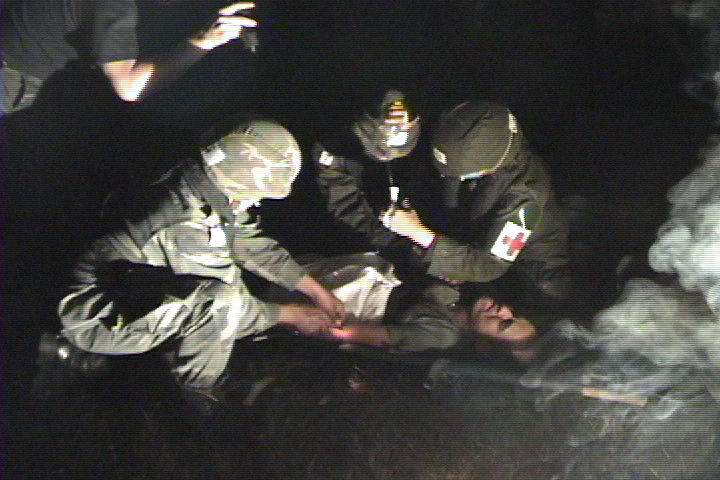
PHASES TRAUMA CARE IN COMBAT TACTICAL LOW.
differences civilian prehospital care and medical tactics are very marked, although the two disciplines oversee the recovery of those injured in tactical medicine, deprives the lack of material and equipment, causes of trauma are different, the environment (conditions of darkness, crossfire, areas with gas, etc.) extreme environments (mountains, desert), the mission of the unit, the evacuation time can be much longer in the tactical environment.
fundamental goals of medicine tactics are: 1 .- Treat
low
2 .- To prevent more casualties.
3 .- Complete the mission.
Tactical Phases of Care combat casualties (CTBC)
care tactical combat casualties, focuses on the prevailing situation, depending on the tactical situation, tactical paramedic staff, will find: Under fire. In the field
tactical
in the evacuation of casualties.
These are the three phases of care tactical combat casualties.
medical care under fire:
This phase is characterized by paramedical personnel are combatants. Among the most important actions to be deprived in this stage is that the medical or paramedical personnel, firepower support to the efforts of other staff, care will focus primarily on eliminating the threat, as this decreases, the actions are focused on providing the best possible care to casualties, provided medical care for the wounded is the first level of response, being implemented by the same low or one of the companions near the injured, the medical equipment available is limited to the medical personnel who carry all the elements and preferably should bring:
1 pad of combat.
1 elastic bandage 10 cm. 1
combat tourniquet (CAT). 1 gauze
combat.
1 pair of gloves. Nasopharyngeal
1.
1 roll of adhesive tape 2 inches. 1 package of drugs
combat (antibiotics and analgesics)
This equipment should be placed in one location in the uniform of all personnel (combatants and noncombatants), so that this form may be accessed on quickly and expeditiously.
During this phase and if necessary the approach to the victims, asked if that is in a position to respond to enemy fire, to hide or even to pretend to be dead in this way decrease the chance of injury Additionally, after being covered with the victim, proceed to the placement of the tourniquet, if necessary. Note that in this phase of medical care under fire, not made Initial assessments of "ABC" The important thing is to respond to hostile fire, remove the victim if possible and exsanguinating wound management, the most convenient way to manage limb injuries is the use of tourniquet combat, not recommended the use of pressure dressings, hemostatic substance use, or other measures to control bleeding. A patient with head and neck injuries by gunshot fire, rarely have spinal cord damage from handling is made in the field, for that reason it is not necessary to stabilize the cervical spine Patients are unanswered (unconscious, not breathing, pulse) will not be resuscitated. At this stage of Tactical Casualty Care in Combat. NOT RECOMMENDED FOR THE IMPLEMENTATION OF cardiopulmonary resuscitation, these maneuvers may help rather than endanger the lives of the rescuers, may even endanger the mission.
Friday, April 16, 2010
Friday, February 12, 2010
Best Online Flower Service
Some Background.
The experiences of combat medics in World War II, Korea and Vietnam, along with his growing understanding of field support, rapid evacuation, transportation and final treatment of those injured in combat are the basis on which care is based tactical combat casualties. While SWAT teams began to appear in the decade 1960, as a result of incidents like the Sniper Tower of Texas, the shooting in Los Angeles with the Symbionese Liberation Army, and many other acts, it was recognized that some form of medical support units would be needed for missions high risk. The proposed model was based on the military model of combat medic, suggesting it was part of the tactical unit. More specifically, these technicians (basic at first and then the paramedic level) was a medical team of special operations. Some of the policemen and paramedics who were these tactical units were often veterans of Vietnam, for many years United States, there were very few units nationwide. A department SWAT team and began the medical program at that time in the 1970's was the Sheriff of Pima County, Tucson, Arizona. Which has been in continuous operation as a SWAT team with the support of clinicians for more than 30 years. It is important to mention that for best performance of a tactical medical team in a public security force, it is necessary to integrate the staff who are trained in three areas: being a police officer, being a provider of medical services and be official special intervention techniques (SWAT techniques). For this reason, and because the high cost of training staff member of these bodies, most SWAT teams, even today, use the external medical support for their team.
Since the 1960's to the 1980's there was a mosaic isolated from the teams that developed their own versions of tactical medical support. The need to revisit the trauma in the tactical environment has been widely recognized. The Tactical Combat Casualty Care Project (CARE tactical combat casualties) was initiated by the Naval Special Warfare Command (Naval Special Warfare Command) in 1993, and continued later by the Special Operations Command (U.S. Special Operations Command (USSOCOM)). This effort developed a set of protocols for trauma in combat Tactics that were published as a supplement in the journal Military Medicine in 1996. CARE guidelines tactical combat casualties provide physicians combat trauma management strategies in combat. CARE The first course in tactical combat casualties took place in 1996 at the Submarine Medical Office sponsored by the Office of Naval Medicine and Surgery (BUMED). Shortly after this training was mandatory for all paramedics of SEAL (special operations in the United States Navy. His name is an acronym Sea, Air and Land (Sea, Air and Earth)). Since then, it has gradually gained acceptance in the military. He has also found wide acceptance in the medical community civilian security forces. Incorporating CARE guidelines tactical combat casualties in the operating Prehospital Trauma Life Support (PHTLS) was an important step in the process of transition from CARE tactical combat casualties. The fourth edition of this manual, published in 1999 contains for the first time a chapter in military medicine. The recommendations contained in the PHTLS Manual carry the endorsement of the Committee on Trauma of the American College of Surgeons and the Association National Emergency Technicians.
The need for regular updating of the guidelines of CARE tactical combat casualties was recognized. The original document recommended that the guidelines were updated as necessary by a committee of the Department of Defense created for this purpose. This concept was approved by the Special Operations Command United States, and the Committee on Tactical Combat Casualty Care of (CoTCCC), which was subsequently founded in 2002 as part of USSOCOM's biomedical research. In 2007, was increased prominence of CARE tactical combat casualties in the Global War on Terrorism. In March of 2008. the CoTCCC was relocated to function as a Board of Health Undersecretary of the Department of Defense of the United States.
The Committee, updating the guidelines based on:
1) in the ongoing review of the literature of civilian and military prehospital medicine;
2) in continuous interaction with the military research labs care for the wounded in combat;
3) first-hand data from combat health, medical,
4) views of both military and civilian experts.
Historically, many of the lessons learned in assisting wounded in the military field have found application in civilian trauma care. Recently, the civilian emergency medical services have been called to assist in numerous school shootings, mall shootings and other acts of terrorism that have tactical factors similar to those found in combat. The threat of receiving hostile fire, having to attend multiple injuries to shed, and prolonged evacuation times have come into play. The massacres at Columbine and Virginia Tech are examples that illustrate that even in urban settings, starting treatment, and transport of injured may require training and tactics outside the parameters of standard protocols SEM. The adoption of the guidelines of the CARE tactical combat casualties in tactical EMS programs and the application of these principles to the tactical operations of Security Forces and the State can result in better continuity tactics and additional lives saved when the wounded are produced during the course of these operations.
The experiences of combat medics in World War II, Korea and Vietnam, along with his growing understanding of field support, rapid evacuation, transportation and final treatment of those injured in combat are the basis on which care is based tactical combat casualties. While SWAT teams began to appear in the decade 1960, as a result of incidents like the Sniper Tower of Texas, the shooting in Los Angeles with the Symbionese Liberation Army, and many other acts, it was recognized that some form of medical support units would be needed for missions high risk. The proposed model was based on the military model of combat medic, suggesting it was part of the tactical unit. More specifically, these technicians (basic at first and then the paramedic level) was a medical team of special operations. Some of the policemen and paramedics who were these tactical units were often veterans of Vietnam, for many years United States, there were very few units nationwide. A department SWAT team and began the medical program at that time in the 1970's was the Sheriff of Pima County, Tucson, Arizona. Which has been in continuous operation as a SWAT team with the support of clinicians for more than 30 years. It is important to mention that for best performance of a tactical medical team in a public security force, it is necessary to integrate the staff who are trained in three areas: being a police officer, being a provider of medical services and be official special intervention techniques (SWAT techniques). For this reason, and because the high cost of training staff member of these bodies, most SWAT teams, even today, use the external medical support for their team.
Since the 1960's to the 1980's there was a mosaic isolated from the teams that developed their own versions of tactical medical support. The need to revisit the trauma in the tactical environment has been widely recognized. The Tactical Combat Casualty Care Project (CARE tactical combat casualties) was initiated by the Naval Special Warfare Command (Naval Special Warfare Command) in 1993, and continued later by the Special Operations Command (U.S. Special Operations Command (USSOCOM)). This effort developed a set of protocols for trauma in combat Tactics that were published as a supplement in the journal Military Medicine in 1996. CARE guidelines tactical combat casualties provide physicians combat trauma management strategies in combat. CARE The first course in tactical combat casualties took place in 1996 at the Submarine Medical Office sponsored by the Office of Naval Medicine and Surgery (BUMED). Shortly after this training was mandatory for all paramedics of SEAL (special operations in the United States Navy. His name is an acronym Sea, Air and Land (Sea, Air and Earth)). Since then, it has gradually gained acceptance in the military. He has also found wide acceptance in the medical community civilian security forces. Incorporating CARE guidelines tactical combat casualties in the operating Prehospital Trauma Life Support (PHTLS) was an important step in the process of transition from CARE tactical combat casualties. The fourth edition of this manual, published in 1999 contains for the first time a chapter in military medicine. The recommendations contained in the PHTLS Manual carry the endorsement of the Committee on Trauma of the American College of Surgeons and the Association National Emergency Technicians.
The need for regular updating of the guidelines of CARE tactical combat casualties was recognized. The original document recommended that the guidelines were updated as necessary by a committee of the Department of Defense created for this purpose. This concept was approved by the Special Operations Command United States, and the Committee on Tactical Combat Casualty Care of (CoTCCC), which was subsequently founded in 2002 as part of USSOCOM's biomedical research. In 2007, was increased prominence of CARE tactical combat casualties in the Global War on Terrorism. In March of 2008. the CoTCCC was relocated to function as a Board of Health Undersecretary of the Department of Defense of the United States.
The Committee, updating the guidelines based on:
1) in the ongoing review of the literature of civilian and military prehospital medicine;
2) in continuous interaction with the military research labs care for the wounded in combat;
3) first-hand data from combat health, medical,
4) views of both military and civilian experts.
Historically, many of the lessons learned in assisting wounded in the military field have found application in civilian trauma care. Recently, the civilian emergency medical services have been called to assist in numerous school shootings, mall shootings and other acts of terrorism that have tactical factors similar to those found in combat. The threat of receiving hostile fire, having to attend multiple injuries to shed, and prolonged evacuation times have come into play. The massacres at Columbine and Virginia Tech are examples that illustrate that even in urban settings, starting treatment, and transport of injured may require training and tactics outside the parameters of standard protocols SEM. The adoption of the guidelines of the CARE tactical combat casualties in tactical EMS programs and the application of these principles to the tactical operations of Security Forces and the State can result in better continuity tactics and additional lives saved when the wounded are produced during the course of these operations.
Tuesday, February 2, 2010
Sometimes My Nose Looks Wide And Sometimes
continue ... Medicine
Up to 90% of wounded in combat died before receiving medical care in a medical setting, the fate and survival rate of these patients are in the hands of who provides the first attention.
differences civilian prehospital care and medicine tactics are very marked, although the two disciplines oversee the recovery of those injured in tactical medicine, deprives the lack of material and equipment, causes of trauma are different, the environment (conditions of darkness, crossfire, areas gases, etc..) extreme environments (mountains, desert), the mission of the unit, the evacuation time can be much longer in the tactical environment.
fundamental objectives are tactical medicine: to treat casualties, prevent further casualties and complete the mission. Phases
Casualty Care in Combat Tactical (CTBC)
care tactical combat casualties, focuses on the situation prevails, depending on the tactical situation, tactical paramedic staff, they were: under fire, tactical field or in the evacuation of casualties. These are the three phases of care tactical combat casualties.
Up to 90% of wounded in combat died before receiving medical care in a medical setting, the fate and survival rate of these patients are in the hands of who provides the first attention.
differences civilian prehospital care and medicine tactics are very marked, although the two disciplines oversee the recovery of those injured in tactical medicine, deprives the lack of material and equipment, causes of trauma are different, the environment (conditions of darkness, crossfire, areas gases, etc..) extreme environments (mountains, desert), the mission of the unit, the evacuation time can be much longer in the tactical environment.
fundamental objectives are tactical medicine: to treat casualties, prevent further casualties and complete the mission. Phases
Casualty Care in Combat Tactical (CTBC)
care tactical combat casualties, focuses on the situation prevails, depending on the tactical situation, tactical paramedic staff, they were: under fire, tactical field or in the evacuation of casualties. These are the three phases of care tactical combat casualties.
Sunday, January 31, 2010
Nike Rn#56323-ca#05553
Tactica, which is it??
Due to the current insecurity in the world in the fight against terrorism and organized crime, care techniques Prehospital have had to be changed, then the term emerging in English Tactical Combat Casualty Care TCCC (Tactical care combat casualties), the relatively recent term emergence takes into account the integrated management of victims in tactical situations, providing medical care according to the situation without risking life and operation, for this reason it is vitally important that the bodies of either pre-hospital care security forces or civilians are aware of these new techniques, which may be necessary in any situation.
Subscribe to:
Posts (Atom)